
Updated
Being empathetic does not make someone an infallible lie detector or give them access to another person’s thoughts. You may notice a change in tone, an inconsistency or your own discomfort. Those observations can be worth exploring, but they do not establish that someone is lying. An impression is a starting point for a question, not proof.
What lie-detection research actually found
In a 2006 meta-analysis by Charles F. Bond Jr. and Bella M. DePaulo, researchers combined findings from 206 documents involving 24,483 judges. In the included tasks, people distinguished lies from truths without special aids or training and averaged 54% correct judgments. That is slightly above a 50% chance benchmark, far from certainty.
This average describes those research tasks. It is not the probability that a particular person is lying today, and it does not establish the performance of a group defined by a spiritual “empath” identity. The study provides no basis for promising that empaths cannot be deceived.
A 2019 review by Aldert Vrij, Maria Hartwig and Pär Anders Granhag also found that nonverbal deception cues are weak and unreliable. Looking away, appearing tense or speaking differently should not be treated as a universal sign of dishonesty. A confident interpretation of body language can still be mistaken.
Separate an observation from its explanation
Compare “They paused before answering” with “They invented the answer.” The first describes something you noticed; the second assigns a cause. You may need more context to understand the pause. The same distinction applies to “They seemed distant” and “They secretly dislike me.”
Empathy can encourage curiosity about someone’s experience. It works poorly as a reason to override what they say about themselves. “You seem quieter than usual; would you like to talk?” leaves space for an answer. “I know what you really feel” closes that space.
Try Notice, Ask and Check
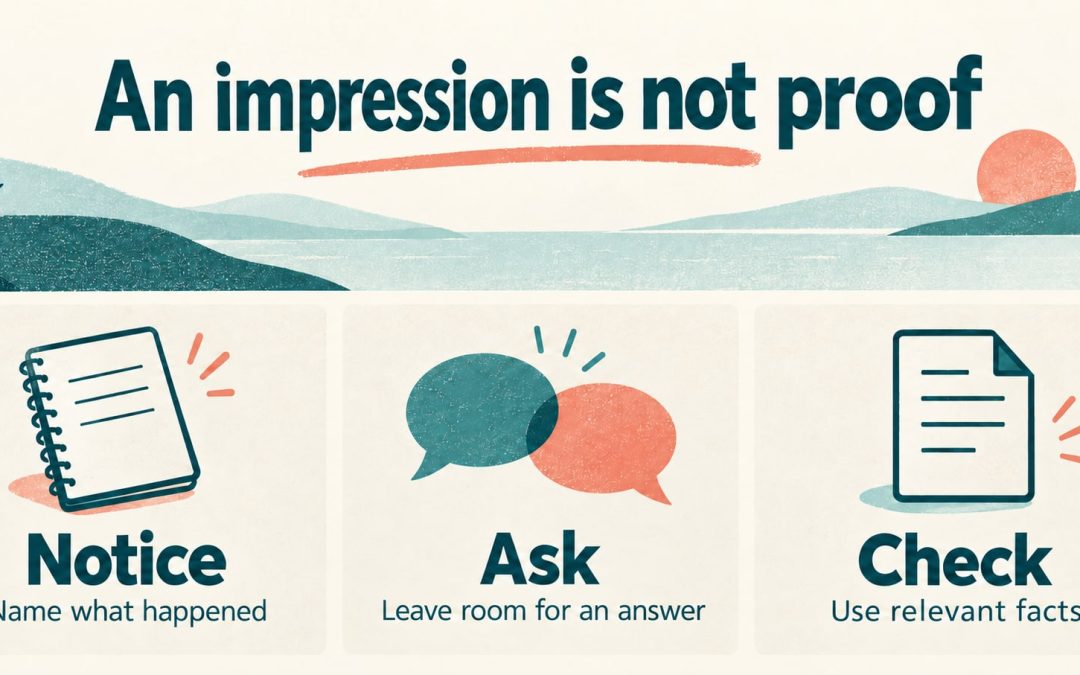
The featured graphic summarizes three communication prompts, reproduced below. They are not a deception test, scoring system or method for proving guilt.
Notice: name what happened
Describe a relevant observation without adding a verdict: “We agreed on Friday, but this message says Monday.” Keep the issue specific.
Ask: leave room for an answer
When it is safe and appropriate, ask a neutral question: “Can you help me understand the change?” Listen before deciding what it means.
Check: use relevant facts
If a decision depends on a fact, review information you are entitled to access, such as your own agreement or receipt. State what remains uncertain.
For example, a missed reply could prompt a conversation about availability rather than an accusation. If an agreed service was not delivered, keep the discussion on the agreement and available remedies. Neither situation requires a theory about someone’s hidden energy.
Respect privacy as well as honesty
Someone can choose not to share personal details. Saying “I do not want to discuss that” is different from making a false factual claim. An empath label does not create a right to passwords, private messages, location access or an explanation of every mood.
Do not pressure someone to disclose more by saying you can already read their soul. If they decline your offer of emotional support, respect the answer. You can explain your own needs or decide what level of trust is appropriate without demanding unrestricted access to theirs.
Boundaries do not require certainty about hidden motives
You can take a practical precaution while acknowledging uncertainty. “I am not ready to lend money,” “I need written terms,” or “I will make this decision after checking the details” describes your choice without claiming to know the other person’s mind.
If there are threats, intimidation or control, prioritize safety and appropriate outside support. Do not confront someone or try to trap them into a confession to test an intuition. If danger is immediate, contact local emergency services.
If constantly trying to read others leaves you tense or physically unwell, our guide to empathy, stress and physical symptoms explains why overload should not be assumed to mean absorbed illness.
If a reader claims they can detect every lie
Ask what evidence supports the claim and how mistakes are handled. A reading should not certify that someone is faithful, diagnose a stranger or settle a serious accusation through intuition alone. A claim of special sensitivity does not remove the need for relevant evidence.
You can value empathy while staying open to correction. The practical aim is a clearer conversation and a decision you can explain, including what you know and what you do not.
Questions to ask before acting on an impression
Before making an accusation or ending a relationship, write the specific observation, at least two plausible explanations, the fact that would change your mind, and the smallest respectful next step. If anxiety is making it hard to slow down, use these Grounding Techniques before returning to the conversation.
Frequently asked questions
Can an empath always tell when someone is lying?
No. Empathy may help someone notice emotion or inconsistency, but it does not provide direct access to another person’s thoughts or guarantee accurate lie detection.
Does avoiding eye contact prove deception?
No. Eye contact varies with culture, neurotype, anxiety, trauma, concentration, and the situation. A single behavior is not reliable proof that someone lied.
What should I do if I sense that something is wrong?
Name the specific observation, ask a neutral question when it is safe, and check relevant facts you are entitled to access. You can set a boundary without claiming certainty about hidden motives.
Can a psychic reading confirm whether my partner is faithful?
No reading can establish fidelity or settle a serious accusation. Use direct communication, consent-respecting evidence, and appropriate professional support rather than intuition alone.