
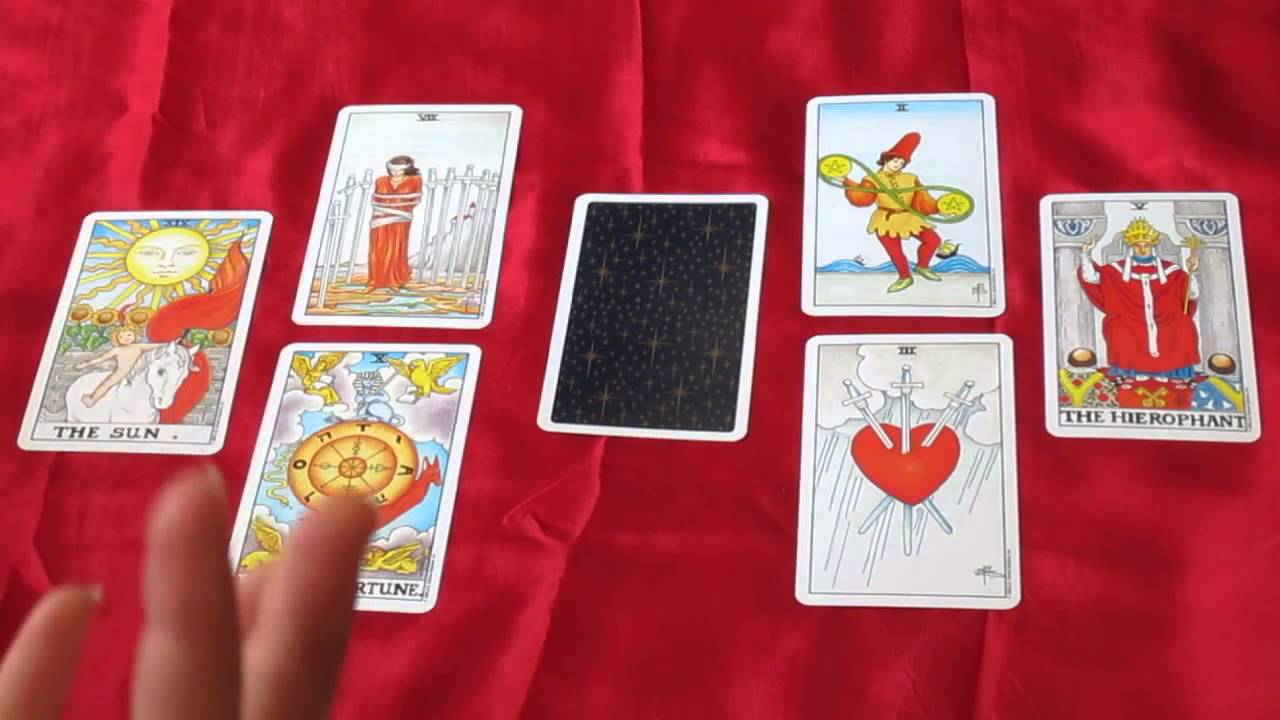
A relationship tarot spread can organize reflection, but it cannot read another person’s private thoughts, guarantee marriage, prove infidelity, or predict whether a relationship will last. Use the cards to examine your own observations, needs, choices, and boundaries.
Prepare the reading
You can use any tarot deck. Choose a quiet place, set a short time limit, and write the question before shuffling. Prefer questions you can act on:
- “What do I need to understand about my role in this pattern?”
- “Which boundary or conversation needs attention?”
- “What evidence am I overlooking?”
- “What are my realistic options over the next two weeks?”
Avoid questions that claim access to someone else’s mind—“Are they secretly cheating?”—or surrender your decision—“Should I leave?” Rewrite them as “Which behaviors concern me, what evidence do I have, and what boundary would protect me?”
A seven-card relationship spread
| Position | Reflection question | Keep it grounded |
|---|---|---|
| 1. Your position | What am I bringing to this relationship? | Name your behavior, needs, assumptions, and choices rather than judging your worth. |
| 2. What you observe | Which actions or patterns am I responding to? | Separate what happened from what you infer about the other person’s motives. |
| 3. Current strengths | What is working and how do I know? | Look for reliability, reciprocity, respect, affection, repair, and compatible goals. |
| 4. Current tension | What needs attention now? | Consider communication, workload, money, trust, intimacy, family, health, or timing. |
| 5. Boundaries and options | What can I choose, request, decline, or change? | Keep the focus on actions within your control; the card cannot obligate another person. |
| 6. Next conversation | What needs clear words? | Draft one respectful question or statement and choose a safe time and channel. |
| 7. Review point | What evidence will I revisit, and when? | Select a date and observable signs; do not make this card a fixed long-term prediction. |
Read each card in three layers
- Card detail: write the name, imagery, suit, number, and first association.
- Personal connection: note what the image reminds you of without declaring it true.
- Grounded action: turn the theme into a question, boundary, conversation, or small experiment.
For example, the Hierophant in position one might prompt questions about tradition, commitment, approval, or shared rules. It does not certify that your role is positive or that the relationship is destined for marriage. The Tower in position four might prompt a review of instability or fear; it does not prove disaster is coming.
Write at least one alternative interpretation. This reduces the temptation to choose only the meaning that confirms what you hope or fear. If a guidebook meaning conflicts with the facts of your situation, prioritize the facts.
Do not use cards to speak for your partner
Position two is about your observations, not telepathy. A card cannot establish whether another person loves you, wants marriage, is faithful, plans to return, or is hiding something. Ask them directly when it is safe, then evaluate consistent behavior over time.
Consent remains current and specific. A “love” card does not override a breakup, blocked contact, a request for space, or a sexual boundary. A difficult card does not justify monitoring a phone, testing a partner, contacting an ex repeatedly, or making an accusation.
Translate the spread into a two-week plan
At the end, choose no more than three actions:
- one question to ask;
- one boundary to state or maintain;
- one behavior to observe until a specific review date.
Record what would change your mind. If the relationship question is about compatibility, the guide to finding the relationship you want offers behavior-based values and consent checks. If you are hoping to meet someone new, use realistic ways to create dating opportunities without treating manifestation as control over another person.
Health, money, and safety limits
Do not use a spread to diagnose pregnancy, fertility, sexually transmitted infections, mental illness, addiction, or another health condition. Use appropriate testing and care. Do not let a card determine a loan, shared account, property transfer, immigration choice, legal filing, or decision about evidence of abuse.
Relationship distress can make repeated readings feel urgent. Set a time and spending limit before beginning. Stop if you keep reshuffling until the preferred card appears, ask the same question repeatedly, buy more readings for reassurance, or feel unable to act without tarot. Put the deck away for at least 24 hours and return to observable facts.
Red flags in a paid relationship reading
- The reader guarantees a reunion, marriage, pregnancy, or exact date.
- They claim a card proves infidelity, a secret admirer, a soulmate contract, or another person’s private intention.
- They diagnose a curse, blocked love, third-party interference, or spiritual attack and demand more payment.
- They encourage surveillance, retaliation, confrontation, or repeated unwanted contact.
- They discourage medical, legal, financial, domestic-violence, or mental-health support.
- They pressure you to extend time or return immediately because the spread is “unfinished.”
Frequently asked questions
Can tarot predict whether a relationship will last?
No card can reliably predict the outcome of a relationship. Use the spread to review current behavior, needs, communication, compatibility, and choices, then revisit observable evidence.
Can a relationship spread reveal what my partner thinks?
No. Cards cannot verify another person’s private thoughts or intentions. Treat that position as a prompt to separate observed behavior from your assumptions and ask directly when appropriate and safe.
What question should I ask in a relationship tarot reading?
Ask an open question about your own understanding or action, such as “What pattern needs attention?” or “Which boundary or conversation would help me respond wisely?”
How often should I repeat the spread?
Set a review date based on real events rather than repeating immediately. Pause for at least 24 hours if you are anxious or seeking a preferred answer, and longer when repeated readings increase distress or spending.